Engineering Strategies in Dealing with Environmental Constraints in Pipeline Installations in Sensitive Coastal Areas
Keywords:
Environmental Constraint, Coastal Sensitivity, Mangrove, Estuary, Coral Area, Ranoute Avoidce, Subsea Pipeline, Engineering PlanningAbstract
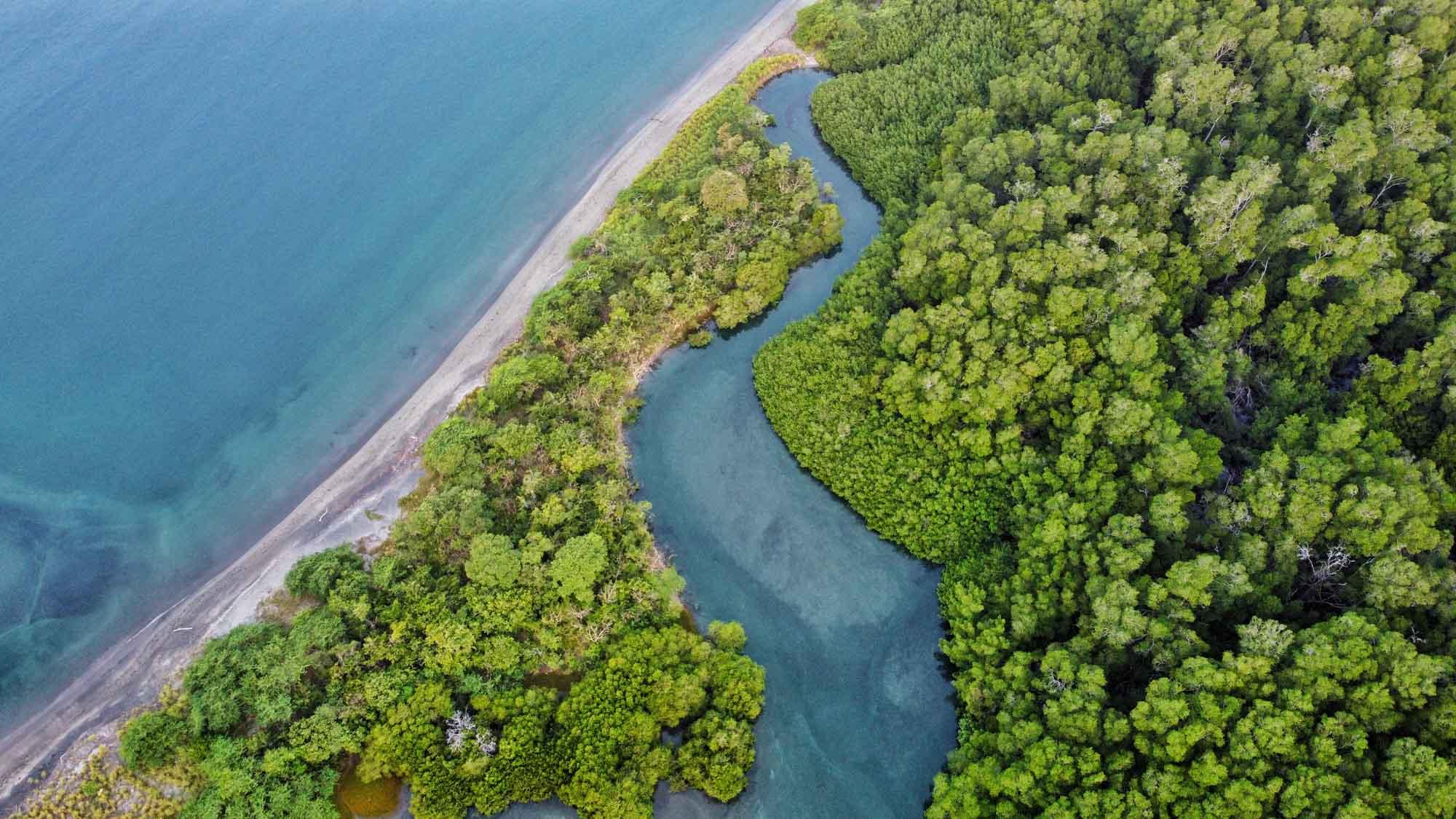
Undersea pipeline route planning in coastal areas requires an approach that integrates engineering and environmental aspects simultaneously from the early stages of design. Based on a literature review of the "Guidelines for Marine and Coastal Environmental Impact Assessment" by the International Finance Corporation as well as scientific publications such as "GIS-Based Multi-Criteria Analysis for Pipeline Route Selection" by Springer and various studies in the journal Ocean Engineering (Elsevier), it is known that environmental constraint is an important parameter in engineering planning. The concept of coastal sensitivity which includes mangrove areas, estuaries, and coral reefs is integrated into the route selection process through a GIS-based approach and multi-criteria decision analysis. The results of the study show that route avoidance strategies for sensitive areas not only significantly reduce ecological impacts, but also improve technical efficiency by minimizing risks such as seabed soil instability, disturbances during installation, and potential additional costs due to advanced mitigation. In addition, international guidelines affirm that avoidance is a priority step before mitigation in the hierarchy of environmental impact management. Thus, route avoidance can be positioned as an integral part of the engineering strategy in undersea pipeline planning, not just a response to environmental regulations, but rather as a design approach that supports the sustainability and reliability of infrastructure in sensitive coastal areas.
Downloads
References
T. Bond, J. Partridge, M. Taylor, T. Cooper, and D. McLean, “The influence of depth and a subsea pipeline on fish assemblages and commercially fished species,” PLoS One, vol. 13, 2018, doi: 10.1371/journal.pone.0207703.
J. Kang and B. Lee, “Optimisation of pipeline route in the presence of obstacles based on a least cost path algorithm and laplacian smoothing,” Int. J. Nav. Archit. Ocean Eng., vol. 9, pp. 492–498, 2017, doi: 10.1016/j.ijnaoe.2017.02.001.
S. Young et al., “Mapping mangrove dynamics and colonization patterns at the Suriname coast using historic satellite data and the LandTrendr algorithm,” Int. J. Appl. Earth Obs. Geoinf., vol. 97, p. 102293, 2021, doi: 10.1016/j.jag.2020.102293.
A. Balogun, A. Matori, A. Hamid-Mosaku, D. U. Lawal, and I. A. Chandio, “Fuzzy MCDM-based GIS model for subsea oil pipeline route optimization: An integrated approach,” Mar. Georesources Geotechnol., vol. 35, pp. 961–969, 2017, doi: 10.1080/1064119x.2016.1269247.
V. Kaushal, M. Najafi, and R. Serajiantehrani, “Environmental Impacts of Conventional Open-Cut Pipeline Installation and Trenchless Technology Methods: State-of-the-Art Review,” J. Pipeline Syst. Eng. Pract., vol. 11, p. 3120001, 2020, doi: 10.1061/(asce)ps.1949-1204.0000459.
X. Yan, S. Ariaratnam, S. Dong, and C. Zeng, “Horizontal directional drilling: State-of-the-art review of theory and applications,” Tunn. Undergr. Sp. Technol., vol. 72, pp. 162–173, 2018, doi: 10.1016/j.tust.2017.10.005.
J. Winterwerp et al., “Managing erosion of mangrove-mud coasts with permeable dams – lessons learned,” Ecol. Eng., 2020, doi: 10.1016/j.ecoleng.2020.106078.
H. H. Farh, M. E. A. Ben Seghier, and T. Zayed, “A Comprehensive Review of Corrosion Protection and Control Techniques for Metallic Pipelines,” Eng. File. Anal., 2022, doi: 10.1016/j.engfailanal.2022.106885.
D. Xie et al., “Mangrove removal exacerbates estuarine infilling through landscape-scale bio-morphodynamic feedbacks,” Nat. Commun., vol. 14, 2023, doi: 10.1038/s41467-023-42733-1.
Y. Ouyang, C. Wang, Y. Wu, J. Zhang, Z. Lin, and L. Cai, “Trend of the environmental supervision on submarine pipeline installation,” Approximately. Sci. Pollut. Res., vol. 25, pp. 28829–28833, 2018, doi: 10.1007/s11356-018-2910-5.
E. Trégarot et al., “Effects of climate change on marine coastal ecosystems – A review to guide research and management,” Biol. Conserv., 2024, doi: 10.1016/j.biocon.2023.110394.
R. Morris, T. Konlechner, M. Ghisalberti, and S. Swearer, “From grey to green: Efficacy of eco‐engineering solutions for nature‐based coastal defence,” Glob. Chang. Biol., vol. 24, pp. 1827–1842, 2018, doi: 10.1111/gcb.14063.
L. Biasotto, F. Becker, R. Nóbrega, and A. Kindel, “Routing Power Lines: Towards an Environmental and Engineering Friendly Framework for Avoiding Impacts and Conflicts in the Planning Phase,” SSRN Electron. J., 2022, doi: 10.2139/ssrn.4052424.
B. Wang et al., “Sustainable crude oil transportation: design optimization for pipelines considering thermal and hydraulic energy consumption,” Chem. Eng. Res. Des., 2019, doi: 10.1016/j.cherd.2019.07.034.
D. Xi, H. Lu, X. Zou, Y. Fu, H. Ni, and B. Li, “Development of trenchless rehabilitation for underground pipelines from an academic perspective,” Tunn. Undergr. Sp. Technol., 2024, doi: 10.1016/j.tust.2023.105515.
S. Meerow, “A green infrastructure spatial planning model for evaluating ecosystem service tradeoffs and synergies across three coastal megacities,” Approximately. Res. Lett., vol. 14, 2019, doi: 10.1088/1748-9326/ab502c.
H. Jia et al., “Adaptive pressure-driven multi-criteria spatial decision-making for a targeted placement of green and grey runoff control infrastructures.,” Water Res., vol. 212, p. 118126, 2022, doi: 10.1016/j.watres.2022.118126.