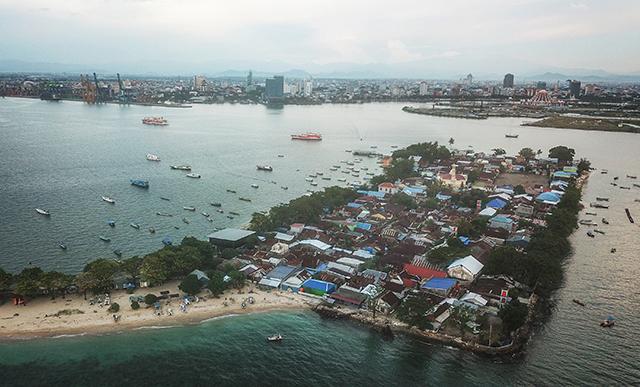
Planning the Clean Water Pipeline Route from Makassar to Kodingareng Lompo Island
Keywords:
Route Selection, Subsea Pipeline, Clean Water, Corridor Planning, Makassar, Kodingareng LompoAbstract
Kodingareng Lompo Island is a small island in the Makassar coastal region that faces persistent clean water shortages due to seawater intrusion, limited freshwater resources, and increasing water demand. One potential solution is the distribution of clean water from mainland Makassar through a subsea pipeline system. In such projects, route selection is a critical planning stage that significantly influences installation feasibility, operational reliability, and long-term project sustainability. This article examines the role of route selection in subsea pipeline planning using a literature-based perspective approach. The discussion focuses on the limitations of conventional shortest-path methods and highlights the importance of considering bathymetric conditions, maritime activities, environmental factors, and installation constraints. The study argues that corridor-based planning and multi-alternative route evaluation provide a more comprehensive framework for decision-making than distance-based optimization alone. Furthermore, route selection should be integrated with installation planning to minimize technical risks and improve system reliability. The findings emphasize that successful clean water distribution to Kodingareng Lompo Island depends not only on hydraulic design but also on the selection of a route that balances technical, operational, environmental, and economic considerations.
Downloads
References
M. B. Manurung, T. E. B. Soesilo, H. Kusnoputranto, I. W. Suryawan, and I. Sianipar, "Health risk analysis of detergent contamination in communities on Kodingareng Lompo Island, Makassar City," J. Presipitasi, vol. 19, no. 2, pp. 426–435, 2022, doi: 10.14710/presipitasi.v19i2.426-435.
D. Lee, J. Park, H. A. Lee, and N. Woo, "A numerical approach to evaluating groundwater vulnerability to seawater intrusion on Jeju Volcanic Island, South Korea," Sustainability, vol. 15, no. 4, p. 3081, 2023, doi: 10.3390/su15043081.
T. Suyono, A. P. Irawan, W. A. Pranoto, and A. Fudholi, "Inter-island freshwater pipeline installation technology with TJ-19 method," Civ. Eng. Archit., vol. 10, no. 6, pp. 2592–2600, 2022, doi: 10.13189/cea.2022.100627.
N. Makrakis, P. Psarropoulos, and Y. Tsompanakis, "GIS-based optimal route selection of submarine cables considering potential seismic fault zones," Appl. Sci., vol. 13, no. 5, p. 2995, 2023, doi: 10.3390/app13052995.
N. Makrakis, P. Psarropoulos, D. Chatzidakis, and Y. Tsompanakis, "Optimal route selection of offshore pipelines subjected to submarine landslides," Open Civ. Eng. J., vol. 16, p. e220922202230, 2022, doi: 10.2174/18741495-v16-e220922-2022-30.
R. Iswara and A. Afriansyah, "Arrangement of submarine cables and pipelines as part of marine spatial planning in Indonesia," Jambe Law J., vol. 5, no. 1, pp. 1–38, 2022, doi: 10.22437/jlj.5.1.1-38.
H. Palippui, "Analysis of the installation of subsea pipelines to support the need for clean water in supporting tourism development on Kayangan Island," Marit. Park J. Marit. Technol. Soc., vol. 1, no. 1, pp. 8–16, 2022, doi: 10.20956/maritimepark.v1i1.19926.
J.-S. Zhu, S. Su, and F.-Q. Chen, "Break-out resistance of offshore pipelines buried in inclined sandy seabed," J. Mar. Sci. Eng., vol. 13, no. 9, p. 1669, 2025, doi: 10.3390/jmse13091669.
U. Arumugam, S. Krishna, R. Milligan, and R. Krishnamurthy, "Assessment of pipeline damages caused by ship anchor-chain drag incidents," in Proc. Int. Pipeline Conf. (IPC), vol. 5, Risk and Reliability; Offshore, Upstream, and Production Pipelines; Emerging Fuels and Greenhouse Gas Emissions, 2024, doi: 10.1115/IPC2024-134100.
P. Huang, X. Meng, H. Dong, and L. Chong, "Numerical modeling of submarine pipeline scouring under tropical storms," Water, vol. 13, no. 10, p. 1425, 2021, doi: 10.3390/w13101425.
D. Karabaić, M. Kršulja, S. Maričić, and L. Liverić, "The optimization of a subsea pipeline installation configuration using a genetic algorithm," J. Mar. Sci. Eng., vol. 12, no. 1, p. 156, 2024, doi: 10.3390/jmse12010156.
N. Sulaiman, N. A. Zakuan, and H. Tan, "Risk based inspection and maintenance strategy for subsea pipelines using Bayesian influence diagram," in Proc. 2nd Int. Conf. Comput. Commun. Netw. (ICCCN 2022), AIP Conf. Proc., 2024, doi: 10.1063/5.0185054.
A. Skretas, S. Gyftakis, and E. Marcoulaki, "A demonstration of sustainable pipeline routing optimization using detailed financial and environmental assessment," J. Clean. Prod., vol. 362, p. 132305, 2022, doi: 10.1016/j.jclepro.2022.132305.
A. Mahjoob, Y. Noorollahi, and M. S. Naghavi, "Spatial analysis for natural gas pipeline routing, monitoring, and high-risk areas identification," J. Pipeline Syst. Eng. Pract., vol. 15, no. 4, p. 04024038, 2024, doi: 10.1061/JPSEA2.PSENG-1473.
D. Karabaić, M. Kršulja, S. Maričić, and L. Liverić, "The optimization of a subsea pipeline installation configuration using a genetic algorithm," J. Mar. Sci. Eng., vol. 12, no. 1, p. 156, 2024, doi: 10.3390/jmse12010156.